
Editor Elena Patera
Welcome to the July issue of Anastomosis. In this issue, we bring you the latest news from our members and from the Journal of Anatomy and Aging Cell.
If you have any news, events or announcements that you would like to see published in the newsletter, please send us an email by the 20th of each month. Items should reach the editor a minimum of 30 days before the date that the event is scheduled to take place. Please remember that you can visit our News Page at any time for the very latest news.
Education Committee Tip of the Month
'Enhancing Engagement and Reducing Sensory Barriers for Neurodivergent Students in Dissection‑Based Learning'
Written by Benedict Falana BSc, MSc, PhD
Anatomy teaching has moved beyond long lectures towards small‑group learning in dissection rooms and prosection facilities. Alongside learning to identify structures (for example, major vessels, bones, and organs), students are expected to develop professional skills such as teamwork, leadership, and communication. For some learners, however, the dissection environment adds extra barriers, particularly students who are neurodivergent (including autistic students and those with ADHD, dyslexia, or dyspraxia). Bright lighting, strong preservative odours, unfamiliar textures, noise, and the pressure to work quickly in a group can be distracting or overwhelming. When this happens, it may look like a student is disengaged, when in reality they are managing sensory overload or processing information differently.
A practical starting point is to normalise that dissection can feel confronting or challenging for many students, not just neurodivergent students. Saying this explicitly before the first session, can reduce stigma and make it easier for students to ask for support early. Anticipatory guidance also helps provide a clear overview of what will happen in a typical session, what students may see and smell, and what participation usually involves. Where possible, share photos, short videos, or a simple step‑by‑step walkthrough (including where to store belongings, when breaks are allowed, and how to get help). Clarity and predictability lower anxiety and allows attention for learning. Because sensory factors are often the biggest challenge, small adjustments can make a meaningful difference without lowering standards. Consider allowing masks that reduce odour, scent‑neutral balms (where safe), and a choice of suitable PPE. Build in permission to step out briefly, and if space allows, identify a quiet nearby area where students can decompress and return when ready. Importantly, staff training matters. Demonstrators and technical staff should be supported to recognise that hesitation, reduced eye contact, or quiet communication may reflect overload rather than lack of interest. Checking assumptions early can prevent students being unfairly labelled as “not suited” to the discipline.
In group‑based sessions, structure supports inclusion: define roles (e.g., reader, pointer, dissector, note‑taker), rotate them by agreement, and provide written prompts so students do not have to rely on rapid verbal exchanges alone. Where learning outcomes allow, offer flexible pathways like observation approaches, working with prosections, using 3D models or digital anatomy platforms, and opportunities to review materials at a slower pace outside the lab. These options can help students demonstrate the same anatomical understanding while reducing unnecessary sensory and social load. Finally, a short check‑in after early sessions (anonymous if needed) can highlight barriers quickly and signal that feedback is welcomed.
Overall, neuro‑inclusive design in dissection‑based teaching is less about special treatment and more about good educational practice in terms of clearer expectations, predictable structure, and sensible sensory considerations. When these supports are built in, neurodivergent students are more likely to participate confidently, and all students benefit from a calmer, and better organised learning environment.
References
Forringer‑Beal, A. (2026). Why Neuro‑Inclusive Universal Design Learning Matters for Students and Staff Alike. University of Manchester, Equality, Diversity and Inclusion Blog.
Oxford University Department of Education. (2024–2025). Neurodivergent Education for Students, Teaching & Learning (NESTL) Toolkit.
Congratulations to the Latest Recipients of Anatomical Society Funding
If you would like to know more about how the Anatomical Society Funds our members, please see our full prize and funding matrix here. This month we would like to congratulate and latest recipients of the society's funding awards and provide you with the reports of the successful endeavours of recent awardees.
The Barclay-Smith Travelling Fund Recipients
The Anatomical Society awards the Barclay-Smith Travelling Fund to AS members to support their attendance at the Anatomical Society Winter or Summer meetings. Congratulations to our most recent awardees! You can also read the approved report of a recent awardee.
2025/26 Round 4
Mr Anas Sulaiman Alkharusi participated in the Anatomical Society Summer Meeting, University of Bristol, Bristol, 15th to 17th July 2026.
Ms Nessrin Almaghtuf participated in the Anatomical Society Summer Meeting, University of Bristol, Bristol, 15th to 17th July 2026.
Mr William Antcliff participated in the Anatomical Society Summer Meeting, University of Bristol, Bristol, 15th to 17th July 2026.
Ms Maricci Basa participated in the Anatomical Society Summer Meeting, University of Bristol, Bristol, 15th to 17th July 2026.
Ms Emily Baxter participated in the Anatomical Society Summer Meeting, University of Bristol, Bristol, 15th to 17th July 2026.
Ms Lorna Brockbank participated in the Anatomical Society Summer Meeting, University of Bristol, Bristol, 15th to 17th July 2026.
Ms Sumar Chan participated in the Anatomical Society Summer Meeting, University of Bristol, Bristol, 15th to 17th July 2026.
Ms Emily Green participated in the Anatomical Society Summer Meeting, University of Bristol, Bristol, 15th to 17th July 2026. Awarded but not taken up.
Ms Alix Hudson participated in the Anatomical Society Summer Meeting, University of Bristol, Bristol, 15th to 17th July 2026.
Dr Juliette Hughes participated in the Anatomical Society Summer Meeting, University of Bristol, Bristol, 15th to 17th July 2026.
Mr Ryan Lukin participated in the Anatomical Society Summer Meeting, University of Bristol, Bristol, 15th to 17th July 2026.
Dr Alannah Mortimer participated in the Anatomical Society Summer Meeting, University of Bristol, Bristol, 15th to 17th July 2026.
Ms Rhieya Rahul participated in the Anatomical Society Summer Meeting, University of Bristol, Bristol, 15th to 17th July 2026. Report
Ms Srishti Ramrakhiani participated in the Anatomical Society Winter Meeting, Trinity College, Dublin, 14th to 16th December 2026.
Anatomical Society Symington Bequest Travel Fund
The Trustees of the Symington Bequest Fund make grants to Society Members towards costs associated with the conduction and dissemination of anatomical research. Congratulations to our most recent awardees!
Round 4
Dr Shane Browne - to participate in the 22nd Congress of the International Federation of Associations of Anatomists (IFAA), ‘Anatomy for Everyone’, Melbourne, Australia, 13th to 16th August 2026.
Professor Kieran McDermott - to participate in the 22nd Congress of the International Federation of Associations of Anatomists (IFAA), ‘Anatomy for Everyone’, Melbourne, Australia, 13th to 16th August 2026.
Dr Ekrem Solmaz - to participate in the 17th International Symposium of Clinical and Applied Anatomy (ISCAA 2026), Vienne, Austria, 3rd to 6th September 2026.
Professor Adam Taylor - to participate in the 22nd Congress of the International Federation of Associations of Anatomists (IFAA), ‘Anatomy for Everyone’, Melbourne, Australia, 13th to 16th August 2026
Anatomical Society Public Engagement and Outreach Awards Reports
The Council of the Anatomical Society launched this initiative in June 2018 to support the public engagement and outreach activities of members of the Society in the field of Anatomy. Congratulations to our most recent awardee!
Round 4
Awardee: Ms Emily Green
Institution: Newcastle University Event dates: 15th October 2026, 6pm to 9pm
Venue: To be held at The Great Northern Museum: Hancock part of Newcastle University
Activity Title: ‘Bits & Bobs: The Anatomy of Sex’. An innovative public engagement event marking World anatomy Day 2026
Anatomical Society Support for Student Societies
The Anatomical Society funds student societies to support them in a range of activities, including inviting a speaker and/or organising a seminar. Congratulations to our most recent awardee!
2025/26 Round 4
Awarded to: Ms Rishita Prabhu
Institution: University of Birmingham
Event Title and Date: International Surgical Anatomy Teaching Series (ISATS)
Location: Virtual MS Teams. A free 15-week series 30.09.26 to 27.01.27, Wednesdays 18:00 to 20:00
New Fellows of the Anatomical Society
Following the May 2026 Council, the Anatomical Society is happy to announce that the following individuals have received the Anatomical Society Fellowship! Many congratulations to our most recent AS fellows!
2025/26 Round 4 (elected by 30.06.26 Council)
Professor Flora Groening
Dr André Toulouse
Deadlines for next round for Receipt of Applications
Award application deadline date for Round 5 of the 2025/2026 award year:
Symington Bequest
Barclay Smith Travelling Fund
Fellowship of the Anatomical Society
Public Engagement and Outreach
Departmental Seminar Awards
Deadline: 26.08.2026
Award application deadline date for Round 5 of the 2025/2026 award year:
Support for Student Societies
Deadline: 12.08.2026
N.B: Round 5 is the last round for academic year 2025/2026. The next round after this one, will be Round 1 of academic year 2026/2027 in October/November 2026 depending on the award.
Anatomical Society Best Image Prize May 2026 Winners
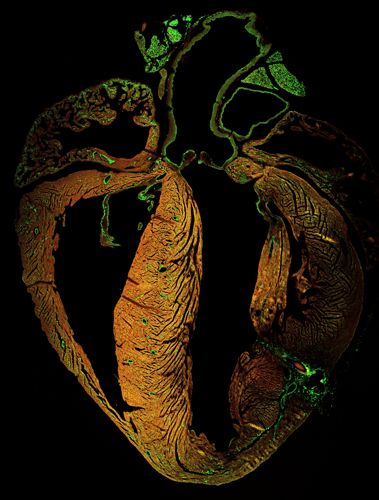
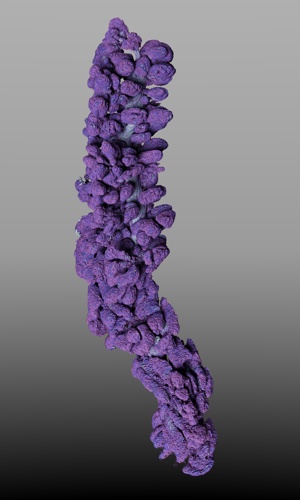
Congratulations to the Anatomical Society Best Image Prize May 2026 Winner Dr Benjamin Chapman (University of Oxford) and runner-up Professor Friedrich Paulsen (Friedrich Alexander University)!
To find out more about the award winning images, check out the information below!
Best Image Award (Science Category)
Image Title |
|
Description
| In the first week of life, the neonatal mouse heart regenerates fully after injury – an ability not shared by humans. Confocal microscopy seven days post-myocardial infarction reveals dense macrophage networks and revascularisation (isolectin-B4, green) in the infarct zone against autofluorescent myocardium (orange), demonstrating innate regeneration as the heart repairs itself. |
Submission Date | 29/05/2026 |
Name(s) of LEAD submitting author(s ) who must be members of the Anatomical Society and institution(s) | Dr Benjamin Chapman |
Name(s) of Other submitting author(s ) and institution(s) | N/A |
The Regenerating Heart
Best Image Award Runner-Up (Science Category)
Image Title | |
Description
| Tissue blocks containing Meibomian glands from cadavers were cut out en bloc after fixation in 4% paraformaldehyde solution and embedded in paraffin wax. Serial sagittal sections were stained with haematoxylin and eosin. These sections were then scanned using a digital slide scanner. All digitised images were transferred and processed using the HiD 3D application (Chimaera GmbH, Erlangen, Germany) to reconstruct and visualise the gland's morphology. This was followed by extensive processing to create a three-dimensional model of a Meibomian gland that is free of non-linear tissue deformations, heterogeneous intensities and low contrast. |
Submission Date | 22.05.2026 |
Name(s) of LEAD submitting author(s) who must be members of the Anatomical Society and institution(s) | Professor Friedrich Paulsen |
Name(s) of Other submitting author(s) and institution(s) | Professor Michael Scholz Dr Simone Gaffling |
Human Meibomian Gland
Cave Young Investigator Poster Prize Award 2026
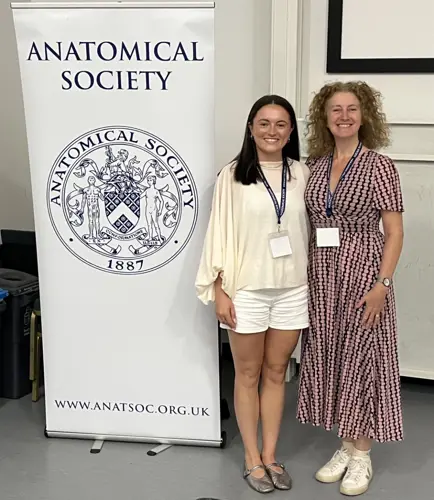
The Cave Young Investigator Poster Prize is awarded for the best poster presented by an attendee, normally of relatively junior status, at the society's Spring/Summer Meeting. Congratulations to our Cave Young Investigator Poster Prize winner Ms Louise Hosty!
2026 Award Cave Young Investigator Best Poster Award, Summer 2026, Bristol
Title: Development of a pro-angiogenic hyaluronic acid hydrogel decorated with vascular cell-derived ECM
Submitted by: Ms Louise Hosty, Royal college of Surgeons in Ireland (RCSI), Dublin
Photo: Ms Louise Hosty and the President of the Anatomical Society, Professor Abigail Tucker
Epilepsy Research Institute UK/AS Co-Funded PhD Award
The Council of the Anatomical Society and the Epilepsy Research Institute UK are delighted to share that the co-funded PhD (Epilepsy Research Institute UK/Anatomical Society) has been awarded to: Professor Chris Rodgers and Dr Thomas Cope at the University of Cambridge. Massive congratulations to the awardees!
In this co-funded studentship, improved ultra-high field MRI techniques will be developed. These enhanced imaging techniques aim to reveal tiny brain abnormalities responsible for epilepsy, helping more patients access curative surgery without invasive testing.
Grant Title: Improving ultra-high field MRI scans to clearly show tiny structural abnormalities that cause epileptic seizures and guide curative epilepsy surgery | Epilepsy Research Institute
Grant Type: Anatomical Society and Epilepsy Research Institute co-funded PhD Studentship grant
Start Date: 01.10.26 to 30.09.29
Grant Amount £110,000
Lead Investigator: Professor Chris Rodgers Co-investigators: Dr Thomas Cope Mr Archie Brown Student: Mr Archie Brown
Institution: University of Cambridge
Winner of the Anatomical Society Prize 2026
The Anatomical Society Prize is awarded biennially on the recommendation of Council to a distinguished morphological scientist. Massive congratulations to Emeritus Professor John Morris for being awarded this prize!
Research Studentship
The Anatomical Society is delighted to announce the award of a new research studentship. This awards are the outcome of the Society’s annual studentship competition open to its members. Congratulations to our most recent awardees!
NEW AWARD SENIOR STUDENTSHIPS
Lead Supervisor: Professor Tanya T. Whitfield University: University of Sheffield
Co-Supervisor : Dr Emily S. Noël University: University of Sheffield
Student: Ms Georgia Tattersall University: University of Sheffield
Project Title: Post-embryonic development and anatomy of the zebrafish inner ear
Anatomy Research Developmental Awards 2026/2027
The Anatomical Society Council is pleased to announce the 2026/27, 'Anatomy Research Development Award' aimed at researchers in the early stages of their academic careers.
Applications are currently being invited from eligible researchers to commence in 2027. The closing date for applications is midnight 31st December 2026.
Anatomical Society Research Studentships 2026/27
Call for Applications
Applications are currently being invited from prospective supervisors for Research Studentships to be held in departments of anatomical sciences in the UK and Ireland starting October 2027. The closing date for applications is 5pm Wednesday 19th August 2026.
For the eighth year, the Society is reserving a studentship for an early career investigator (ECI). An ECI is a person with a lectureship or independent research fellowship who is within 12 years of being awarded a PhD, exclusive of career breaks, who has guaranteed employment for the duration of the studentship and who has not held an AS PhD Studentship previously. The application will be judged according to different criteria than the regular studentship submissions with more emphasis on project design and training provided than on track record. The proposal will still have to meet the high standard expected.
The advertisement, application forms, information and conditions can be found on the website:
Alternatively, contact the Honorary Secretary, Professor Joanna Matthan, care of maryanne.piggott@kcl.ac.uk
“Figuring and Describing”: Leonardo and the History of Anatomy
Summer School Opportunity in Cesena, Italy
A Summer School will take place from 8th to 10th of September 2026 at the Malatestiana Library in Cesena, Italy as part of COST Action CA24143 (European Cooperation in Science and Technology). Entitled “Figurare e descrivere”: Leonardo e la storia dell’anatomia / “Figuring and Describing”: Leonardo and the History of Anatomy, the event will feature lecturers from various universities and an Italian- and English-language programme focusing on Leonardo as an anatomist.
Please click here for further details on how to apply and the summer school.
The Summer School offers 18 places, including 10 scholarships for Master’s and PhD students, and may be of interest to your students.
The application deadline is 10 August 2026.
Upcoming Conferences
22nd Congress of the International Federation of Associations of Anatomists (IFAA), 13th-16th August 2026, Melbourne, Australia
Standard registration for the 22nd IFAA Congress is still available!
This is an opportunity to share our work, insights, and innovations with a global audience of colleagues and thought leaders in anatomy and related fields, including:
Anatomical Sciences Education
Surgical and Clinical Anatomy
Imaging Anatomy
Neuroscience and Cell Biology
Ethics and Law
Anatomy for Everyone, including Biological Anthropology, Forensics, Histology, Developmental Anatomy/Embryology
For more information regarding the registration, please visit this link: https://ifaa2026.org/en-AU/pages/registration/registration
Institute of Anatomical Sciences
Autumn 2026 Scientific Meeting
2nd-3rd of September
The Institute of Anatomical Sciences Autumn 2026 Scientific Meeting will be held at the Human Anatomy Resource Centre (HARC) at the University of Liverpool between 2nd-3rd of September 2026. During the meeting a variety of subjects will be covered including perspectives from students who are just starting their careers as well as those who are well established. There will be various workshops including a 3D printing workshop, an embalming workshop and a HTA workshop. We will showcase technical achievements in science and academics talks in Veterinary science, Dentistry and Anatomy to name a few.
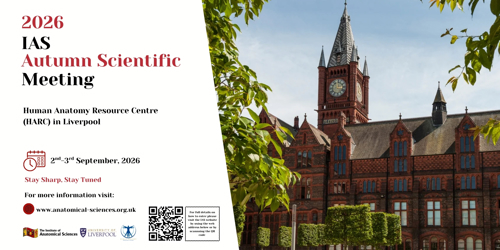
For more information on how to register and the meeting's programme please check out this document.
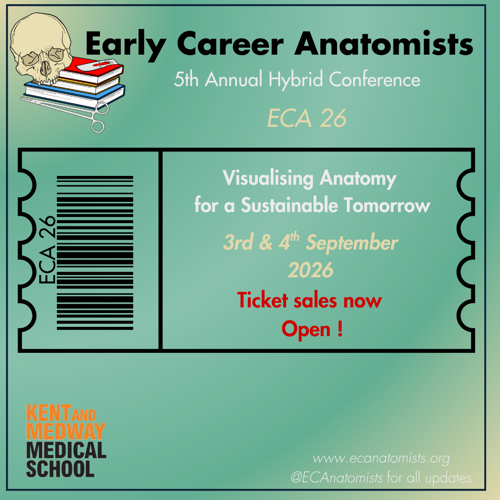
5th Early Career Anatomists Conference
The Early Career Anatomists group is hosting their annual hybrid conference from September 3rd to 4th 2026 at Kent and Medway Medical School, Kent, UK.
If you are interested in attending, please check out the information below:
Journal of Anatomy
For a summary of many of the published articles check out @JournalofAnat. As a member of the Anatomical Society you have access to these articles and to the Journal of Anatomy through Wiley Online Library.
Access the journal here.
The cover image for the latest issue is from a paper by Camille Pluchot, Mélody Morisse, Maryse Meurisse, Jean-Marie Graïc, Elodie Chaillou, Scott A. Love, titled 'Cytoarchitecture and myeloarchitecture of the sheep auditory cortex'.
This study aimed to characterise the cytoarchitecture and myeloarchitecture of the sheep auditory cortex, revealing a conserved six-layered organisation and identifying the potential location of the primary auditory cortex.
Access the paper here
The cover image for the journal's July issue is shown below:
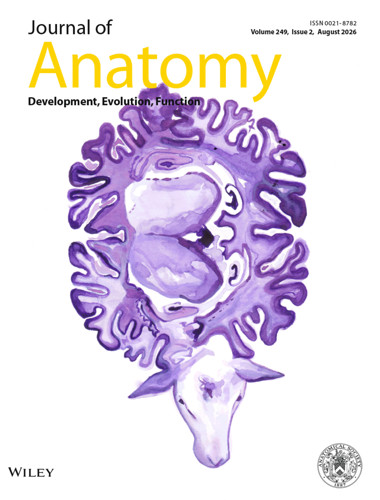
Image by Elsa Maury.
Aging Cell
Aging Cell is a bi-monthly peer-reviewed, open access journal that aims to publish the highest quality, innovative research addressing fundamental issues in the biology of aging. We would like to remind you that our colleagues Aging Cell are now back on X and sharing exciting news and updates on articles from their journal. Please give them a follow @aging_cell
Access the journal here: Aging Cell